• Injury
  • Pilates
  • UKSCA TRAINER AWARD
  • Strength and Conditioning
    • Lifestyle training >
      • Lifestyle training for adults
      • Youth training programme
    • Performance training
    • On-line Training >
      • On-line Performance Training >
        • Athlete monitoring
    • Home exercise support
  • About
    • Andrew Taylor
    • Claire Taylor
    • Testimonials
    • Blog
  • Contact
    • General Enquiry
Taylormade Rehab - Devon
  • Injury
  • Pilates
  • UKSCA TRAINER AWARD
  • Strength and Conditioning
    • Lifestyle training >
      • Lifestyle training for adults
      • Youth training programme
    • Performance training
    • On-line Training >
      • On-line Performance Training >
        • Athlete monitoring
    • Home exercise support
  • About
    • Andrew Taylor
    • Claire Taylor
    • Testimonials
    • Blog
  • Contact
    • General Enquiry

Common foot injuries experienced by runners

11/15/2023

0 Comments

 
Foot pain is common in runners for a number of reasons. The very nature of running makes it a high impact repetitive activity. The impact of that force is primarily experienced in the foot where mild imbalances will have a significant effect. The highly complex synergy between the muscles, ligaments and bones in the foot relies on these tissues working in harmony. Foot pain can be long standing and niggly and can often end up making it almost impossible to run. Identifying these injuries and their causes can be crucial to a pain free return to the open road!
Here are some common foot injuries suffered by runners.
 
Plantar Fasciitis 
Picture
What is it and what causes it?
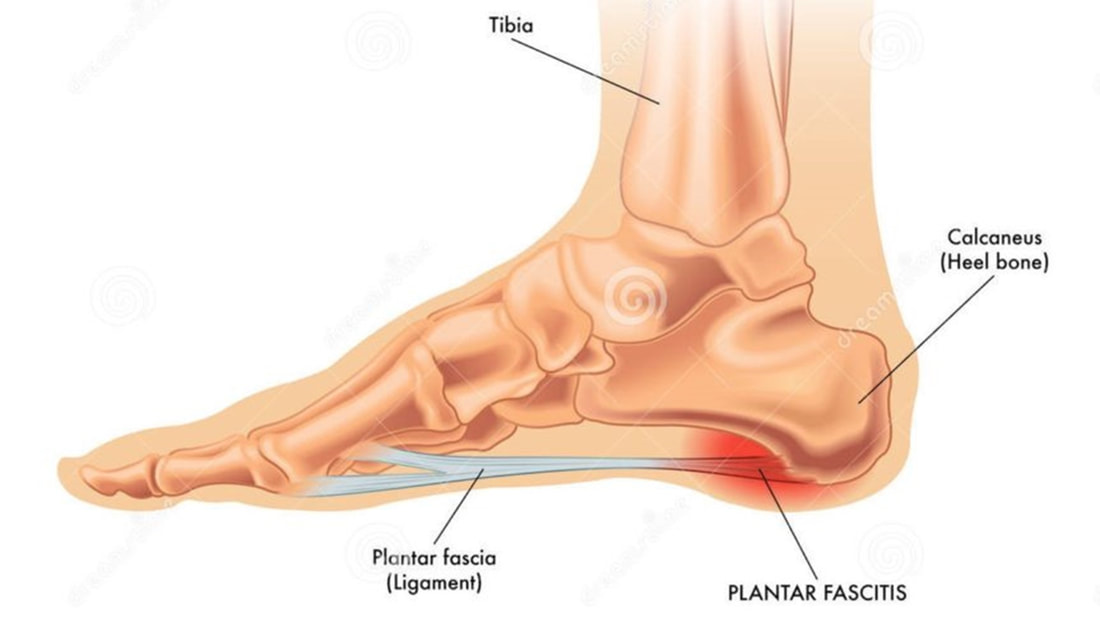
The Plantar Fascia is a thick wide band of strong connective tissue. This ligament connects the heel bone (Calcaneus) to the base of the toes (Metatarsals). Its primary role is to support the arch of the foot helping to dissipate the load through the foot.
Most commonly, Plantar Fasciitis is considered an overuse injury which occurs when a repetitive force is created that the plantar fascia can no longer support. Over time this can create a degeneration of the Plantar Fascia.
Onset of pain may occur following an intense introduction to a new activity such as running or a sharp increase in training intensity. Predisposing factors to this injury might be excessive tightness in the calf and insufficiency in supportive footwear.
A sharp pain is experienced in the sole of the foot close to the heel. The pain is usually at its worst following a prolonged period of rest, specifically first thing in the morning, which may ease slightly after a few steps. Symptoms may be aggravated once again following exercise or long periods of standing.
How to treat it?
  • Restricting pain eliciting activities such as running and jumping. Consider alternative low impact activities early in recovery such as swimming or cycling.
  • Stretching the calf muscles. Although a thorough stretch of the posterior chain (back, glutes and hamstrings) would be beneficial.
  • Massaging/Myofascial release. This can be carried out with ice or just a ball. It may be beneficial to massage the whole posterior chain. Caution should be expressed with depth of massage directly to the plantar fascia whilst pain is intense.
  • Appropriate strengthening exercises for the lower limb.
  • Application of specific taping techniques can assist the load bearing role of the plantar fascia offering support.
  • Arch supportive footwear may aid recovery.
  • If it doesn’t settle seek medical advice.
How to prevent it?
  • Ensure increases in training load are steadily progressed.
  • Stretch daily throughout the lower limb, particularly as part of your training recovery programme.
  • Establish any biomechanical/body alignment involvement.
  • Carry out appropriate strength training to address lower limb imbalances and support to the arch.
  • Seek advice from professional regarding the possible requirement of insole or footwear support recommendations. 

Stress Fracture
Picture
What is it and what causes it?
A stress fracture is a small crack in the bone. It is so small it is often not even picked up on an x-ray. A stress fracture occurs along the continuum of a bones’ stress reaction. If caught early enough a stress reaction will present as a bone bruise, if symptoms are ignored or stress load is not adapted sufficiently then a stress fracture will develop.
Pain on weightbearing is the most significant symptom. This is worse on impact and settles at rest. It is often a localised sharp pain pinpointed to the site of the fracture. Swelling on the top of the foot can be observed depending on the fracture’s location.
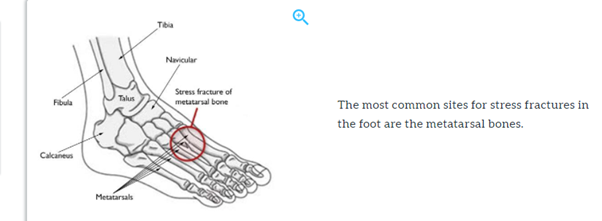
The most common running related stress fractures in the foot are along the 2nd or 3rd Metatarsal. This is the site of greatest load as the foot moves through the push off phase of the running gait. Depending on foot mechanics, they can also be present  in the Calcaneus, Talus or Navicular bone.
Occurring as an overuse injury, a stress fracture will develop over a period of time. It is frequently reported to affect the lower limb in high impact repetitive activities such as running and jumping. A bone is at risk of a stress fracture when a sudden increase in training load and intensity is experienced. This may equate to increasing the number of running sessions in a week or running longer distances. Other factors causing a stress fracture may be a change in surface conditions from soft to hard, inappropriate, or unsupportive footwear or bone insufficiency.
How to treat it?
  • R.I.C.E (Rest, ice, compress and elevate) protocol is most beneficial in the first 24-48 hours of an acute flare up.
  • Prevent all impact activities such as running for the first 4-8 weeks. Specifically, whilst pain is present.
  • Alternative non-impact activities such as swimming and cycling would be advocated.
  • NSAIDs (anti-inflammatory drugs) may help manage pain and swelling.
  • It is advisable to seek medical advice as it may be appropriate in certain cases to provide weightbearing aids such as crutches or an air boot.
 
How to prevent it?
  • Introduce new activities such as running in a steady progressive programme.
  • When increasing the intensity and volume of running ensure this is carried out as a gradual progression and there is adequate recovery time between training sessions to allow for the sufficient bone remodelling following the previous training session.
  • Upon returning to running after a longer break period ensure that you commence your programme at a lower intensity than previous and build back up to the distance and frequency that you were last training at.  
  • Consider cross training to vary the training load.
  • Runners with osteoporosis or low levels of Vitamin D may consider a very gradual increase in duration and frequency of training to ensure the bones have optimal time to adapt to the impact load without causing too much stress.
  • Ensure a healthy balanced diet to encourage Vitamin D absorption for improved bone health.
  • Ensuring the use of appropriate footwear, which provides adequate shock absorbency.

Metatarsalgia and Morton’s Neuroma
​
Picture
Picture
​What is it and what causes it?
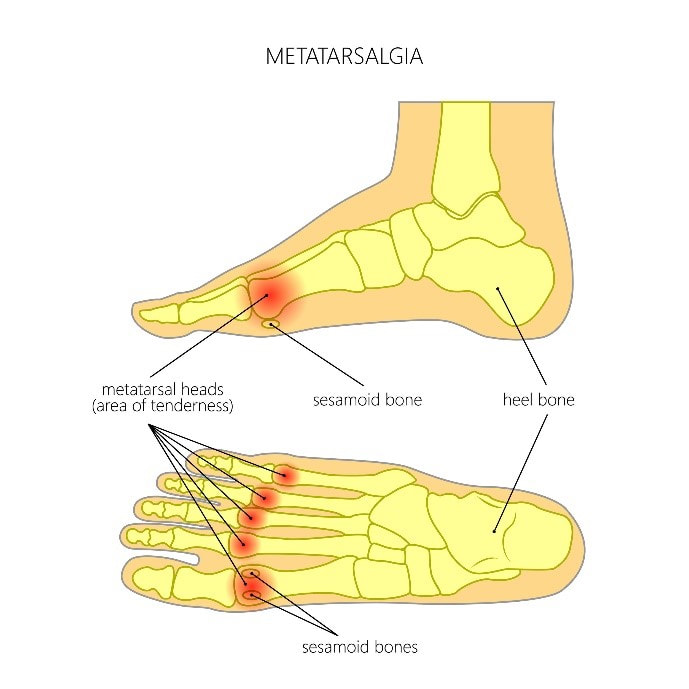
Metatarsalgia refers to inflammation to the heads of the Metatarsal bones (these bones sit in the forefoot between midfoot and toes). This occurs when there is a repetitive trauma to the sole of the foot such as the impact of running and jumping.
Pain can develop suddenly or over a period of time and is experienced in the ball of the foot. This pain can be described as sharp, aching, or burning which often get worse with standing, walking or running. This condition can be similar to a Morton’s Neuroma where the tiny nerves between the toes are affected. Both can present with similar symptoms of pain and tingling or numbness. The most significant difference is in the site of pain. A Morton’s Neuroma usually affects the space between the 3rd and 4th toes where a thickening in tissues can be felt. This is often described as having a small pebble in the shoe.
Other non-related running causal factors could be, excessive wearing of high heels, wearing of ill-fitting shoes, foot deformities such as bunions or hammer toe, obesity and diabetes.
How to treat it?
  • There may be some benefit to icing the foot for 20minutes at a time following aggravating activities.
  • Restricting pain eliciting activities such as running.
  • Avoiding barefoot weightbearing activities whilst experiencing pain.
  • NSAIDs (anti-inflammatory drugs) may help manage pain.
  • Wearing a shock absorbing shoe with a wide foot and low heels.
  • Potentially introduce metatarsal pads or gel insoles.
  • If it doesn’t settle seek medical advice.
How to prevent it?
  • Ensure supportive shoes when running with good arch support, sufficient width at the ball of the foot and effective shock absorbency.
  • Replace worn-out running trainers to ensure gait and shock absorbency are not compromised.
  • Ensure adequate recovery between intense training sessions. Building up gradually to adapt to new training loads.
  • Maintain lower limb stretching routine. Specifically, the calves.
  • Maintain full range of ankle movement (specifically Dorsiflexion) to allow for a comfortable foot strike. Forefoot runners can suffer more with Metatarsalgia due to the excessive high impact on the balls of their feet.
Maintaining a healthy, strong foot when you are asking it to absorb the heavy load of running frequently through out your week is key to remaining comfortable and pain free. It is important to remember foot health such as adequate care and attention to blisters, regular toenail cutting, treatment of calluses and even stretching and massage of the feet. These actions can all help reduce load imbalances in your gait, preventing injury and providing your feet with the best recovery environment.
 If in doubt about any symptoms or pain does not settle, it can be most helpful to seek advice from a registered Health Care Practitioner to ensure that you have an accurate diagnosis and to ensure an effective treatment plan is prescribed.
0 Comments

Your comment will be posted after it is approved.


Leave a Reply.

    Picture

    Taylormade
    blog


    ​Archives

    August 2024
    July 2024
    June 2024
    December 2023
    November 2023
    February 2022
    August 2021
    May 2021
    December 2020
    May 2020
    April 2020
    March 2020
    September 2019

    Categories

    All
    Children
    Lifestyle
    Sports Injuries
    Sports Studies
    Youth Sport

    RSS Feed

Picture

PERFORMANCE AND REHABILITATION CLINIC
​Injury Management and Conditioning Specialist
​
​

ABOUT US

PRIVACY POLICY

CONTACT US

Taylormade Rehab, 1 Belle Vue, Fenny Bridges, Honiton, Devon ​EX14 3BJ | 07800 824557 | 07855 386634​
© 2019 Taylormade | Performance & Rehabilitation Clinic. Injury Management & Conditioning Specialists | Website design by brightblueC
  • Injury
  • Pilates
  • UKSCA TRAINER AWARD
  • Strength and Conditioning
    • Lifestyle training >
      • Lifestyle training for adults
      • Youth training programme
    • Performance training
    • On-line Training >
      • On-line Performance Training >
        • Athlete monitoring
    • Home exercise support
  • About
    • Andrew Taylor
    • Claire Taylor
    • Testimonials
    • Blog
  • Contact
    • General Enquiry